
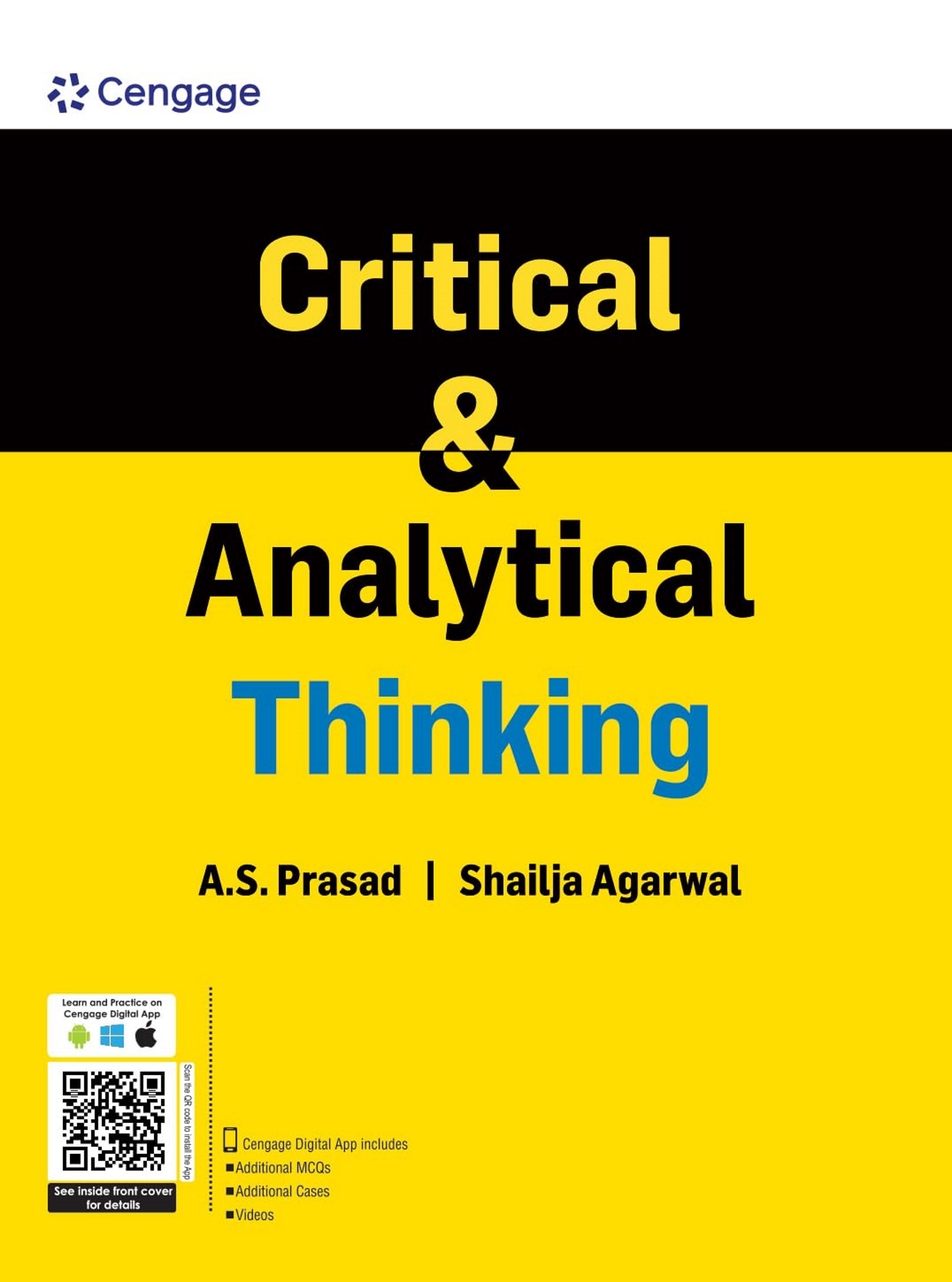
Book
Critical and Analytical Thinking
A Holistic Approach to Logical Reasoning, Structured Problem-Solving and Decision-Making
Cengage India, 2024
Co-authored with Prof. Shailja Agarwal, IMT Ghaziabad
About this book
This book provides a clear, domain-independent framework that guides you through any complex problem or decision — step by step. It presents a holistic approach that integrates critical thinking skills with structured frameworks for reliable, evidence-based outcomes.
The Core: Two Frameworks
Problem-Solving Framework
Used when the cause of a problem is unknown and needs to be diagnosed.
Problem Definition → Hypotheses → Evidence → Analysis → Root Cause → Solutions → AISI → Decision
Decision-Making Framework
Used when choosing between options — vendor selection, market entry, investment decisions, hiring.
Decision Statement → Options → Criteria → Evidence → Analysis → AISI → Decision
AISI — built into every decision: Assumptions, Implications, Stakeholders, Implementation Risks. The elements most frameworks leave implicit.
The Toolkit: Critical Thinking Skills
To execute the frameworks without bias or error, the book builds your foundational skills:
Logical Reasoning
Deductive, inductive, and causal reasoning techniques for structured argument analysis.
Credibility and Evidence
How to evaluate credibility of claims, sources, and arguments with systematic criteria.
Moral Reasoning
Understanding various perspectives in moral reasoning and their application.
Navigating Obstacles
Recognizing and countering linguistic obstacles, rhetorical devices, logical fallacies, and cognitive biases.
The Holistic Approach
This is not a collection of disjointed concepts. The frameworks give you the process, and the toolkit sharpens the quality of thinking you apply during that process. This integrated approach ensures that critical thinking becomes a reliable, repeatable skill rather than an abstract concept.
Who it is for
While structured as a textbook, this book is valuable for:
- Critical thinking courses in colleges and universities
- MBA programs teaching case study analysis
- Corporate training and induction programs
- Law school students
- GRE/GMAT/CLAT aspirants and Watson-Glaser test preparation
- Professionals seeking to systematically learn critical thinking
- Educators seeking a teachable, comprehensive methodology
For educators
Instructors using this textbook have access to:
- PowerPoint presentations
- Case studies and exercises
- Sample assessments
About the authors
A.S. Prasad developed the critical thinking frameworks presented in this book. A management graduate from IIM Ahmedabad (1981-83), he has been teaching critical thinking since 2013 at institutions including IIM Indore, IMT Ghaziabad, IIM Rohtak, and NIFT. He has delivered corporate training for Amazon, McCormick (USA), HCL, GE Healthcare, and others.
Prof. Shailja Agarwal is Chair, Business Communications at IMT Ghaziabad. She contributed case studies and supported the academic adaptation of the material into textbook form.