
Book
About this book
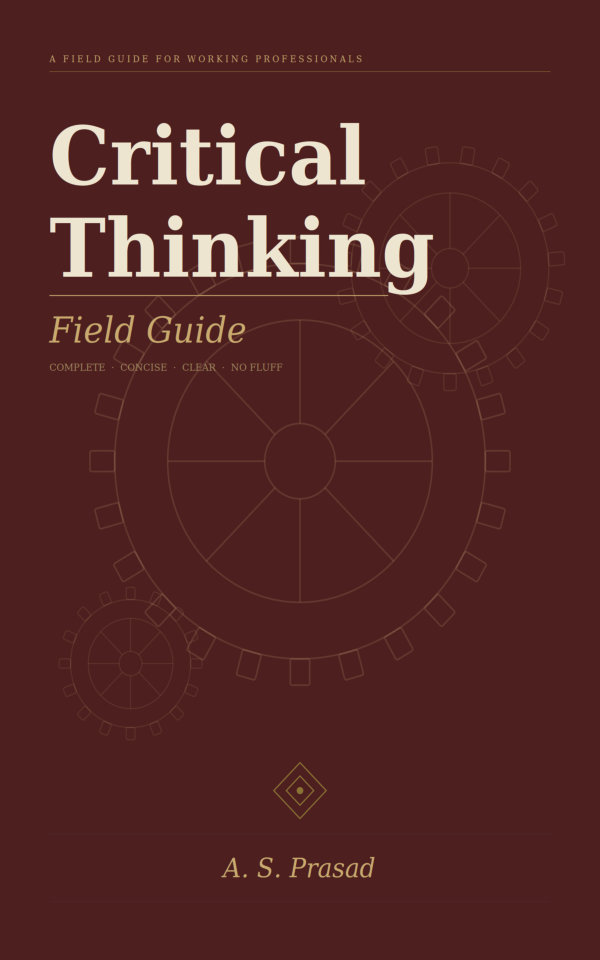
Critical thinking is widely recognised as the most important professional skill of the current era. The problem is not access to material: the problem is time. Most books on the subject are long on context and short on the concepts themselves.
This Field Guide takes the opposite approach. Every concept is stated clearly and completely, paired with one practical example, and then the book moves on. No extended stories, no repetition, no padding. The result is a book that covers the entire subject in a format that a working professional can read and use.
The book covers all three dimensions of critical thinking as a unified system: the structured frameworks for problem-solving and decision-making; the four forms of logical reasoning; and the four categories of barriers that quietly derail clear thinking, even when the rest of the reasoning is sound.
It is written for managers, executives, and professionals who want a complete picture of the subject, delivered without waste.
What this book covers
Dimension 1 | Frameworks
Problem-solving and decision-making
A complete, structured framework for problem-solving and decision-making that makes every relevant dimension explicit: issue, criteria, hypotheses, evidence, analysis, and solutions, each evaluated against assumptions, implications, stakeholder views, and implementation risks. Presented as three separate frameworks for problem-solving, decision-making, and evaluation.
Dimension 2 | Logical Reasoning
The four forms of logical reasoning
Deductive reasoning, inductive reasoning, causal reasoning, and moral reasoning, each with its sub-types, its criteria for a strong argument, and the ways it typically goes wrong. Also covers evaluating credibility and the structure of logical persuasion using the Minto Pyramid Principle.
Deductive: categorical syllogism, hypothetical syllogism, modus ponens, modus tollens, disjunctive syllogism, enthymeme. | Inductive: generalisation, specific-to-general, convergent arguments, reasoning by analogy, argument evaluation. | Causal: causal structures, Mill's Methods, inference to the best explanation, six common errors. | Moral: factual and moral reasons, three schools of moral philosophy.
Dimension 3 | Barriers to Clear Thinking
Cognitive biases, fallacies, rhetorical devices, and linguistic barriers
The four categories of obstacles that undermine clear thinking, each covered completely. Understanding them is not optional: they operate regardless of how good the rest of the reasoning is.
15 cognitive biases | 16 fallacies | 25 rhetorical devices | 7 linguistic barriers
Who it is for
Managers and executives who want a reliable reference on the full scope of critical thinking, written at professional level and without unnecessary length.
MBA and postgraduate students who want the concepts covered properly, in a format that respects their time.
Anyone who has read about critical thinking in fragments, from different sources, and wants the complete picture in one place.
Participants in corporate critical thinking training programmes who want a reference to accompany workshop learning.
Read almost half the book free
The free preview includes the Introduction to Critical Thinking, Deductive Reasoning (full chapter), Causal Reasoning (full chapter), 15 cognitive biases, 16 fallacies, and the table of contents. No sign-up required.
Download free previewAbout the author
A.S. Prasad is the founder of the Critical Thinking Academy and an alumnus of IIM Ahmedabad. After three decades in senior management across FMCG, media, and IT, he has spent the past decade designing and delivering critical thinking programmes for executives and students at corporate organisations and premier academic institutions across India.
He has trained more than 4,000 people at organisations including Amazon, GE Healthcare, McCormick, and HCL, and at institutions including IIM Rohtak, IIM Vizag, IIM Nagpur, IMT Ghaziabad, and NIFT. He is the lead author of Critical and Analytical Thinking (Cengage India, 2024) and the author of The Hidden Traps of Persuasion (2023) and Critical Thinking for Watson-Glaser (2026).
Get your copy
Also available on Amazon Canada and Amazon Australia. Available as Kindle ebook and paperback.