
Chapter 5
Causal Reasoning for Watson-Glaser Test Prep
By A S Prasad, Critical Thinking Academy
Causal reasoning is the logic of why. It connects events: X happened because of Y. In everyday life, we rely on this constantly — but cause-and-effect links are often where reasoning errors occur.
Strong causal reasoning involves recognising when a cause-and-effect claim is well supported and when it is weak or unjustified. It requires asking whether the evidence truly shows that one event caused another, or whether the connection might be coincidental or explained by other factors.
Even when a question or argument doesn't explicitly mention "cause" or "effect," many forms of reasoning depend on causal links. Learning to recognise and evaluate these links strengthens reasoning across every context.
Causal Reasoning Across the Watson Glaser Tests
Causal reasoning appears across multiple sections of the Watson-Glaser. Understanding these patterns will help you spot when causality is being claimed and when those claims are justified — or not.
Inference
Passages often describe events in sequence, such as:
"Profits rose after the new CEO was hired."
The tempting inference is: "The CEO caused the profits to rise." However, this leap is unjustified unless explicit evidence supports it. The correct reasoning is to withhold judgement — the timing alone is not enough. Correlation does not prove causation. When causality is not established, the correct answer is Insufficient Data.
Assumptions
Many assumptions rest on implied cause-and-effect links.
Argument: "We should invest in training to improve sales."
Hidden assumption: "Training causes sales to improve."
The reasoning task is to recognise that this causal link is being taken for granted. If the link fails, the argument collapses.
Deduction
Causal statements may appear as part of a deductive argument, such as: "If sales fall, then costs will be cut." In such cases, the reasoning task is not to assess whether this causal claim is realistic. The focus is purely on structure — whether the conclusion logically follows from the stated reasons. The content of the cause-and-effect relationship is irrelevant.
Interpretation
Causal reasoning also appears when we interpret evidence:
"Sales fell during a recession. Therefore, the recession caused the sales decline."
This conclusion is plausible but not certain. The coincidence of two events is not enough to prove causation. The passage only establishes that both events happened at the same time. It does not rule out other causes, such as a failed product launch or new competition. Therefore, the causal link remains unproven.
Common Causal Fallacies
Causal reasoning errors are among the most frequent in argument evaluation. You don't need to memorise the names — but you do need to understand the logic behind each one.
1. Post Hoc Fallacy — Confusing Sequence with Cause
This fallacy assumes that because Event B happened after Event A, A must have caused B.
Example: "Profits rose after the new manager arrived; therefore, the manager caused the rise."
Flaw: The timing could be coincidental. The rise might have been caused by earlier product launches, market trends, or competitor failures.
2. Cum Hoc Fallacy — Confusing Correlation with Causation
This fallacy assumes that because two things happen together, one must be causing the other.
Example: "Cities with more hospitals also have more crime; therefore, hospitals cause crime."
Flaw: Both variables are related to a third factor: population size. Larger cities need more hospitals and statistically have more crime. The correlation is real, but the causal interpretation is false.
3. Reversing Cause and Effect
This error identifies a genuine relationship between two factors but mistakes the direction of causality.
Example: "Confident people are successful; therefore, confidence causes success."
Flaw: It is equally, or more, plausible that success builds confidence. The argument assumes a one-way causal direction without considering the reverse.
4. Oversimplification — The Single-Cause Fallacy
This fallacy reduces a complex outcome to a single cause, ignoring other important contributing factors.
Example: "The recycling programme is the sole reason our public image improved."
Flaw: Public image is influenced by many factors — marketing, service quality, corporate ethics, and media coverage among them.
5. Self-Selection Bias
This error occurs when the people or groups being compared have chosen their own situation, making it impossible to know whether the situation caused the observed outcome.
Example: "Employees who joined the voluntary wellness programme took fewer sick days than those who didn't. Therefore, the programme improves health."
Flaw: People who voluntarily join wellness programmes are likely already more health-conscious. The programme may not be making them healthier — they were probably healthier to begin with. You cannot compare people who chose to join with people who didn't join, and conclude that joining made the difference.
What Makes a Causal Argument Strong
Weak causal arguments rely on coincidence or assumption. Strong ones are supported by evidence. They typically do three things:
1. Provide evidence for the link
A strong argument doesn't just assert causation — it provides consistent evidence.
"Before launch, average sick days were 4.1 per employee; after launch, they dropped to 2.9."
2. Explain the mechanism — how A leads to B
A strong argument explains how the cause produces the effect.
"The programme gives employees access to health screenings and nutrition counselling. By identifying risks early and improving diet, the programme directly reduces preventable illness."
3. Rule out obvious alternatives
Sound causal reasoning anticipates competing explanations and eliminates them.
"We checked other factors: insurance policies remained unchanged, no major public health events occurred, and competitors' sick-day averages stayed stable."
Causal Reasoning in Practice
These examples show how causal reasoning appears across different Watson-Glaser question types.
Example 1 — Inference
Passage: "After the company introduced a new performance bonus scheme in June, overall sales increased in July."
Statement: "The bonus scheme caused the increase in sales."
Answer: Insufficient Data
The passage shows correlation, not causation. Other factors — seasonal demand, competitor activity — could explain the rise.
Example 2 — Assumptions
Argument: "The board should increase investment in staff training, because this will lead to higher productivity."
Question: What is the underlying assumption?
Answer: That staff training actually causes productivity to increase.
The argument depends on that causal link being true. If training does not cause productivity to increase, the argument collapses.
Example 3 — Interpretation
Passage: "During the past year, the company's profits declined at the same time that raw material costs rose."
Which conclusion is most reasonable?
A. Rising costs caused profits to decline.
B. The decline in profits was caused by multiple factors.
C. The timing of rising costs and falling profits coincided.
Answer: C
The passage establishes timing, not causality. It does not provide evidence of cause or rule out other explanations.
Example 4 — Evaluation of Arguments
Argument: "Our company's profits increased by 15% this year. We should therefore give our new CEO a large bonus, because this profit growth occurred after the new CEO was hired."
Answer: Weak Argument
This commits the post hoc fallacy — assuming sequence implies cause. Many other factors could explain the profit growth, and no evidence is offered to support the causal link.
Why Causal Reasoning Matters
Thinking clearly about cause and effect strengthens every part of logical reasoning. It helps prevent premature conclusions, reveals hidden assumptions, and improves the quality of judgement.
Causality is rarely mentioned by name, but it's constantly in the background. By learning to separate correlation from causation and evidence from assumption, you sharpen your ability to see how ideas, events, and arguments truly connect.
Exercises: Spotting Causal Reasoning
In these exercises, you'll practise identifying causal claims and recognising flawed causal reasoning.
For each scenario, identify whether a causal claim is being made and, if so, whether it is justified or flawed.
Scenario 1
"After we redesigned the company website, online sales increased by 30% the following month. The redesign clearly caused the sales increase."
Causal claim? Yes
Justified or Flawed? Flawed
This is a post hoc fallacy. It assumes that because the redesign came before the sales increase, it must have caused it. Other factors — such as a seasonal spike or a concurrent marketing campaign — could explain the rise. The reasoning confuses sequence with cause; correlation does not imply causation.
Scenario 2
"We know that smoking causes lung cancer because studies show that people who smoke have a much higher rate of lung cancer than non-smokers, and researchers have identified the biological mechanism by which tobacco smoke damages lung cells."
Causal claim? Yes
Justified or Flawed? Justified
This is a strong causal argument. It presents both strong correlation (smokers have higher cancer rates) and a clearly identified mechanism (tobacco smoke damages lung cells). The causal link is supported by consistent evidence and a plausible biological explanation.
Scenario 3
"Our most productive employees all drink coffee. Therefore, to improve productivity, we should provide free coffee in the office."
Causal claim? Yes (implied)
Justified or Flawed? Flawed
This argument commits the cum hoc fallacy — confusing correlation with causation. It observes a pattern ("productive employees drink coffee") and treats it as a causal link ("providing coffee will cause higher productivity"). The reasoning ignores other explanations: perhaps productive employees drink coffee to maintain energy, or a third factor (like motivation) drives both behaviours.
Scenario 4
"The company introduced free lunches for employees. Since then, employee productivity has increased. The free lunches must be improving productivity."
Causal claim? Yes
Justified or Flawed? Flawed (Insufficient Evidence)
This is a weak causal argument because it assumes causation from sequence. Free lunches feel like a positive change, and the conclusion seems reasonable on the surface — but the argument provides no evidence to rule out other explanations, such as new project deadlines, a restructured team, or seasonal workload changes. The timing alone is not enough to establish causality.
Free Preview
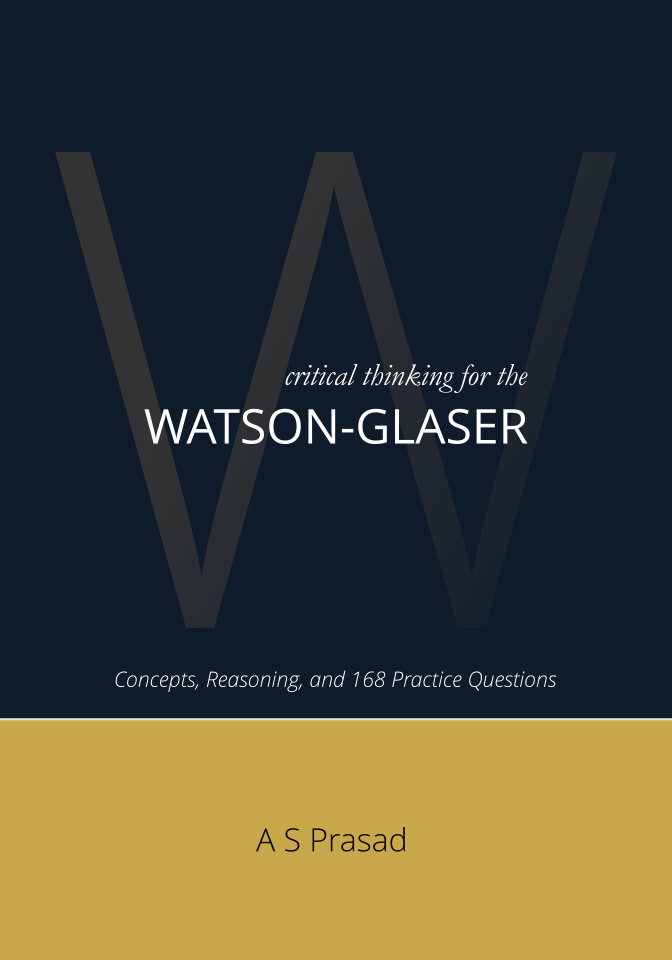
Critical Thinking for Watson-Glaser
Download three full chapters and 15 sample questions for Watson Glaser Practice with complete answers — free. The full book has 168 Watson Glaser Test Practice questions
Download Free Preview
A S Prasad
Founder, Critical Thinking Academy. Author of Critical Thinking for Watson-Glaser and lead author of Critical and Analytical Thinking (Cengage India, 2024). He has trained more than 4,000 professionals in critical thinking at organisations including Amazon and GE Healthcare, and at institutions including IIM Rohtak and IMT Ghaziabad. MBA, IIM Ahmedabad.
Critical Thinking Field Guide
Comprehensive. No fluff, no long stories. Written for the working professional.
Download a preview copy →