
Critical thinking is the one skill AI can't replace.
Critical thinking is the capability employers rank high — and the one most curricula assume students absorb on their own. We bring a complete, applied critical thinking program to your students and your faculty, as visiting faculty and through course development.
Critical thinking rests on three capabilities
It is the ability to reach clear, well-reasoned judgements. Remove any one capability and the thinking fails.
Logical reasoning
Evaluating whether a conclusion truly follows from the reasons given for it — across the four forms, each with its own structure and its own ways of going wrong — plus weighing the credibility of claims, sources, and research used as evidence, and communicating reasoning in structures that are hard to dismiss.
Structured problem-solving & decision-making
A complete, generic framework that forces every dimension of a problem into view — assumptions, implications, stakeholder perspectives, and execution risks. Well-known frameworks each leave gaps; what is left unexamined is where the risk sits. This one makes every dimension explicit, every time.
Awareness of the barriers
Four categories of barrier derail thinking no matter how sound the reasoning. You cannot become a good critical thinker without learning to recognise them — in your own thinking and in others' arguments.
Each capability closes a different failure mode. All three are needed.
Why critical thinking, for students
In their studies
What separates a student who memorises from one who actually reasons through the material — analysing, evaluating, constructing arguments.
Across disciplines
A business case is structured problem-solving. A legal argument is logical reasoning. A medical diagnosis is causal reasoning. Awareness of barriers cuts across all of them.
In selection
Interviews, group discussions, and statements of purpose all test the same thing — can this person reason clearly, structure an argument, and communicate it.
On the job
Precisely the capabilities employers rank highest — and the ones AI cannot supply for them.
Critical thinking in the age of AI
AI produces fluent, confident output whether or not the reasoning behind it is sound. A case analysis, a legal argument, a research summary — all read as coherent regardless of whether the logic holds, the evidence suffices, or every dimension was considered.
Judging that output takes all three capabilities: logical reasoning to test whether conclusions follow, a framework to check whether the analysis is complete, and awareness of barriers to catch the biases and fallacies in it. Framing a good prompt takes the same clarity of thought — and a student who lets AI do the thinking never builds the capability to think independently.
AI makes critical thinking more necessary, not less.
What we offer
Teaching students directly
Visiting faculty sessions, guest lectures, and workshops covering all three capabilities — logical reasoning, structured problem-solving, and the barriers — scoped to your requirements.
Faculty development workshops
Equipping your faculty with the full set of concepts — and with practical ways to bring critical thinking into the subjects they already teach and into their students' work.
Course development & institutional support
Course design, teaching materials, and faculty preparation — so your institution can offer critical thinking as an ongoing part of the curriculum and teach it independently.
A text for students, a guide for faculty
Two companion books support the programme — one built for the classroom, one for faculty development.
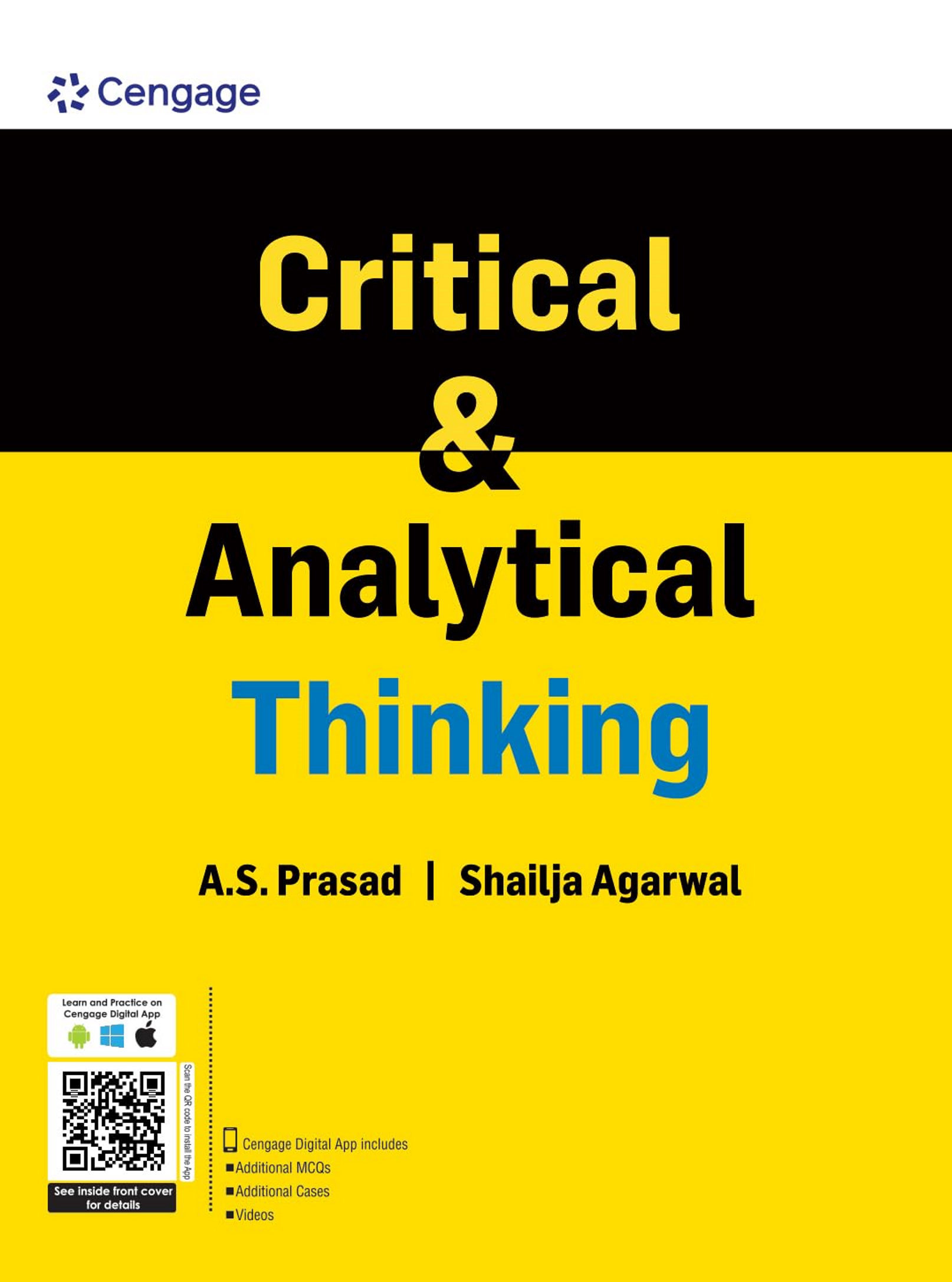
Critical and Analytical Thinking
Co-authored with Prof. Shailja Agarwal (IMT Ghaziabad) · Cengage India, 2024. Built for classroom use — the complete system with cases, exercises, and assessments.
Find it on Amazon India →Critical Thinking Field Guide
A complete, concise reference covering all three capabilities — the companion for faculty and faculty-development programmes. Available worldwide on Amazon, in print and Kindle.
Find it on Amazon →Institutions we've worked with
A.S. Prasad
Visiting faculty · Speaker · Trainer · Author
A management graduate of IIM Ahmedabad (1981–83) with three decades in marketing and senior management — Disney character franchising, FMCG, software distribution, and IT services. Drawing on that experience, in 2013 he designed this critical thinking program to make the discipline genuinely useful for work and life — shifting it away from purely academic theory toward practical application.
He has since trained over 4,000 executives and students. Alongside this work in higher education, he runs corporate programmes for organisations including Amazon, McCormick, HCL, GE Healthcare, and EPAM.
Bring critical thinking to your institution
Tell us your students, your goals, and the time available, and we'll shape an engagement around them — a guest lecture, a workshop, a credit course, or faculty development.