
Chapter 1
Foundations of Watson-Glaser Reasoning
By A S Prasad, Critical Thinking Academy
The Watson-Glaser Critical Thinking Appraisal has one purpose: to measure how well you reason. It doesn't test what you know, but how you think. The assessment evaluates your ability to analyse information, follow logic, and judge arguments objectively. Success depends on your skill in logical reasoning — not on memorising facts or formulas, but on thinking clearly and systematically about the information you're given.
Part 1: What the Watson-Glaser Measures
The Watson-Glaser is built around a specific model of critical thinking called the RED model:
R — Recognise assumptions
E — Evaluate arguments
D — Draw conclusions
The test measures these three skills as indicators of your critical thinking capability. To test these skills, the Watson-Glaser evaluates your performance across five specific areas:
Inference
Deciding if a conclusion is True, Probably True, Insufficient Data, Probably False, or False, based solely on a given passage.
Recognition of Assumptions
Identifying the unstated reasons a conclusion takes for granted — reasons that must be true for the conclusion to hold.
Deduction
Determining if a conclusion follows with absolute logical certainty from the information given.
Interpretation
Judging whether the passage provides adequate grounds to believe the conclusion is true.
Evaluation of Arguments
Determining whether an argument is strong or weak.
Part 2: The Language of the Test
To do well on the test, you need to understand logical reasoning — the core skill in critical thinking. This book uses Watson-Glaser terminology throughout, so you won't be confused when you see the actual test.
Logical reasoning has three core terms:
Conclusion: What the argument tries to convince you of.
Reason: A statement that supports the conclusion by justifying it.
Argument: A conclusion along with its supporting reason or reasons.
In logical reasoning, an argument is not a quarrel or disagreement. It's simply a conclusion supported by reasons.
Example
"You should carry an umbrella because it is going to rain."
The conclusion is: you should carry an umbrella.
The reason is: it is going to rain.
A note on Watson-Glaser format
On the Watson-Glaser, the "Argument" field presents arguments in compressed form. Here is what this looks like:
Question: Should we invest in employee training programs?
Argument: YES; such programs have been shown to increase productivity by up to 15%.
The YES means: "Yes, we should invest in employee training programs because..." The YES or NO represents the conclusion. The text after the semicolon provides the reason. When you analyse these arguments, mentally expand the YES or NO into the full conclusion. The complete argument reads as: [YES, we should invest in employee training programs] because [such programs have been shown to increase productivity by up to 15%].
Part 3: Two Techniques
Technique 1: The "Because" Test
To see how the parts of an argument fit together, use a simple mental check: insert the word "because" between the conclusion and the reason. This turns the argument into one clear sentence:
"(This is the conclusion) because (this is the reason)."
The "Because Test" helps you put the argument into a logical structure, making it easier to see whether the reason supports the conclusion. The test itself does not tell you whether the argument is strong or weak — you still need to evaluate the reasoning. But it gives you a clear framework for understanding what the argument is claiming.
Technique 2: Judging an Argument as Strong or Weak
In the Evaluate Arguments section, your goal is to decide whether an argument is Strong or Weak. This decision follows a two-part test:
1. Is the reason relevant? Does it directly support the conclusion?
2. Does the reason provide adequate grounds? Assuming the reason is true, does it give sufficient support to accept the conclusion as reasonable?
A Strong Argument passes both tests. A Weak Argument fails at least one — either the reason is not relevant to the conclusion, or it does not provide adequate support, or it fails on both counts.
Important: You must always assume the reason is true, even if in the real world you may believe it is not true or not always true. The Watson-Glaser requires you to evaluate whether the reason (assuming it is true) provides strong justification for the conclusion.
Exercises: Deconstructing Arguments
In these exercises, you'll practise identifying Conclusions and Reasons, and applying the "Strong vs. Weak" framework using the Because Test.
For each argument below:
- Identify the Conclusion and the Reason.
- Mentally apply the Because Test: "(This is the conclusion) because (this is the reason)."
- Judge the argument as Strong or Weak based on relevance and adequate grounds.
Exercise 1
Question: Should we invest in employee training programs?
Argument: YES; such programs have been shown to increase productivity by up to 15%.
Conclusion: We should invest in employee training programs.
Reason: Such programs have been shown to increase productivity by up to 15%.
Answer: Strong Argument.
The Because Test shows a clear logical connection. The reason directly supports the conclusion, as it addresses a key outcome of the proposed action. Assuming the reason is true, it provides adequate grounds to accept the conclusion as reasonable.
Exercise 2
Question: Was the new marketing campaign effective?
Argument: YES; we saw a 20% rise in website traffic during the duration of the campaign.
Conclusion: The new marketing campaign was effective.
Reason: We saw a 20% rise in website traffic during the duration of the campaign.
Answer: Strong Argument.
The reason is directly relevant, as website traffic is a key indicator of marketing performance. Assuming the reason is true, it provides adequate grounds to accept the conclusion as reasonable.
Exercise 3
Question: Should the company build a new factory in Green Valley?
Argument: YES; the CEO of our company grew up in Green Valley.
Conclusion: The company should build a new factory in Green Valley.
Reason: The CEO of our company grew up in Green Valley.
Answer: Weak Argument.
The Because Test reveals no logical connection between the reason and the conclusion. The reason is irrelevant, as the CEO's personal background does not relate to the practical factors that determine a suitable factory location. Even if the reason is true, it provides no adequate grounds to accept the conclusion as reasonable.
Free Preview
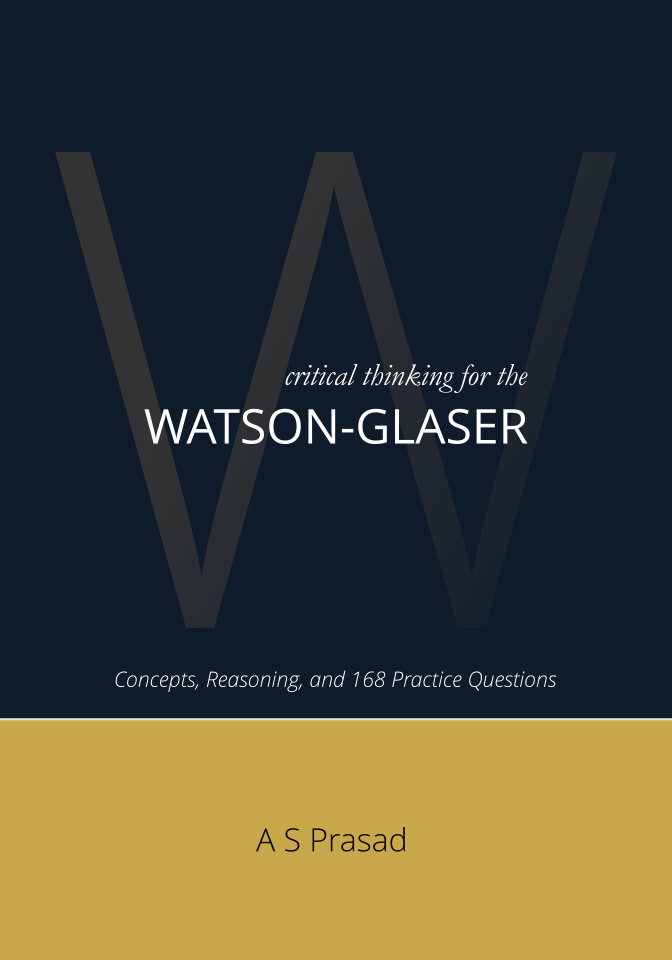
Critical Thinking for Watson-Glaser
Download three full chapters and 15 sample questions with complete answers — free.
Download Free Preview
A S Prasad
Founder, Critical Thinking Academy. Author of Critical Thinking for Watson-Glaser and lead author of Critical and Analytical Thinking (Cengage India, 2024). He has trained more than 4,000 professionals in critical thinking at organisations including Amazon and GE Healthcare, and at institutions including IIM Rohtak and IMT Ghaziabad. MBA, IIM Ahmedabad.
Critical Thinking Field Guide
Comprehensive. No fluff, no long stories. Written for the working professional.
Download a preview copy →